




The Mazda MX-5 (marketed as Miata in North America) occupies unique status in global automotive culture a car so fundamentally right that it requires no apologies, no excuses and no elaborate justification. Yet enthusiasts universally embrace the MX-5 as the ultimate project car platform. Not because it’s flashy or rare. Not because it’s objectively the quickest. The MX-5 commands genuine respect from serious project car builders because its lightweight platform, proven mechanical foundation and enormous aftermarket support ecosystem create optimal conditions for extracting maximum value from modest modification budgets.
For Australian project builders, the MX-5’s accessibility, spare parts availability and enthusiast community make it arguably the smartest entry point into track-focused vehicle building.
Why Lightweight Matters: Physics Over Brute Force
The original 1989 MX-5 weighed approximately 1,000 kilograms. Even current generation MX-5 variants remain under 1,200 kilograms genuinely lightweight by modern standards. This fundamental mass advantage transforms everything. A 1,100-kilogram car with 130 kilowatts accelerates with urgency that 1,600-kilogram vehicles weighing 50% more cannot match regardless of power advantage.
This principle underpins MX-5 project car philosophy: lightweight first, power second. Removing non-essential weight (rear seats, soundproofing, interior trim) yields better performance improvement per dollar than engine modifications alone. A 150-kilogram weight reduction equals approximate 15-kilowatt power gain in practical acceleration without dyno certification, engineering reports, or modification compliance headaches.
Compare this to competitors. A BMW E36 project car demands weight reduction exceeding 300 kilograms to achieve equivalent performance benefit. An E36 starting from 1,350 kilograms requires far more aggressive intervention than the MX-5 platform.
Modification Pathways: From Budget to Extreme
MX-5 project scalability represents genuine advantage. Beginner builders can improve significantly with AUD $5,000-$8,000 budgets. Moderate projects demand AUD $15,000-$25,000. Serious competition builds invest AUD $40,000+. Every budget tier yields meaningful improvement.
Budget Track Build (AUD $8,000-$12,000):
• Lightweight 15-inch wheels (AUD $1,200-$1,800)
• Performance brake pads and fluid upgrade (AUD $600-$800)
• Suspension bushes replacement (AUD $1,200-$1,600)
• Intake and exhaust system (AUD $1,500-$2,200)
• Lightweight battery (AUD $400-$600)
• Minor weight reduction (AUD $1,500-$2,000)
Result: Improved handling, braking and modest power increase (10-15%) without compliance issues.
Moderate Performance Build (AUD $20,000-$30,000):
• Coilover suspension system (AUD $2,500-$3,500)
• Aftermarket differential with limited-slip (AUD $1,500-$2,500)
• Upgraded braking system (four-piston calipers, larger rotors: AUD $3,000-$4,500)
• ECU tuning and modest turbocharger (AUD $5,000-$8,000)
• Weight reduction (120-150 kg: AUD $3,000-$5,000)
• Interior harnesses, roll bar (AUD $2,000-$3,000)
Result: Significant performance transformation approximately 40-50% power increase, radically improved handling, genuine track-day credibility.
Serious Competition Build (AUD $45,000-$70,000+):
• Engine rebuild with higher compression pistons (AUD $6,000-$9,000)
• Larger turbocharger with full boost control (AUD $4,000-$6,000)
• Engine management standalone ECU (AUD $3,000-$5,000)
• Sequential gearbox conversion (AUD $8,000-$12,000) if desired
• Race suspension (Öhlins, Stance, etc.: AUD $5,000-$8,000)
• Full interior weight reduction (200+ kg: AUD $5,000-$8,000)
• Aerodynamic package (wings, splitters, diffusers: AUD $4,000-$6,000)
Result: 150-200+ kilowatt engine capable of sub-7-minute Nurburgring lap times, genuine motorsport-competitive platform.
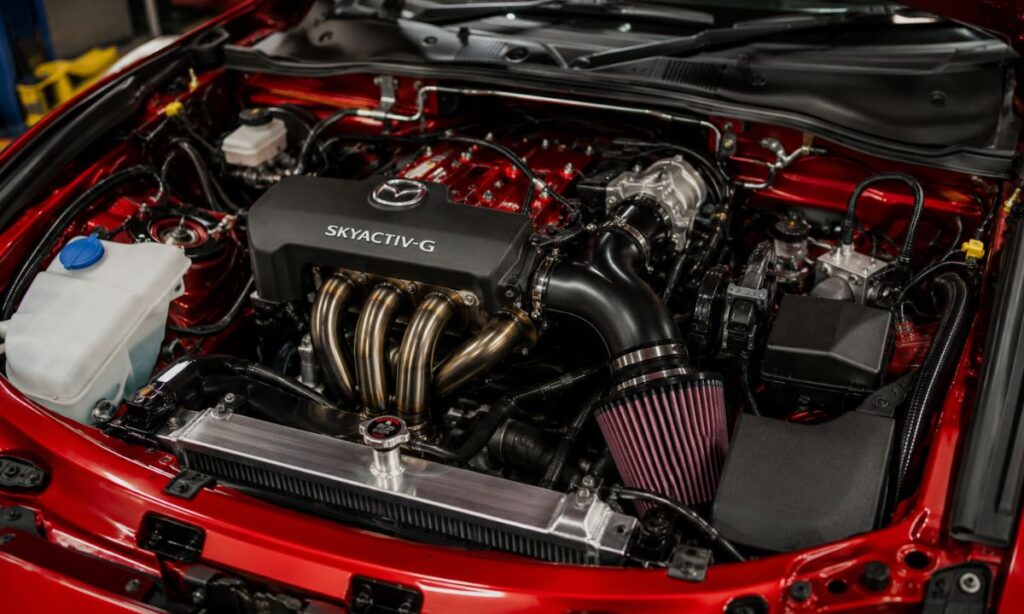
Aftermarket Support: The Unseen Advantage
MX-5 aftermarket ecosystem rivals substantially more expensive platforms. Dedicated suppliers (Flyin’ Miata in USA, Moss Motors, various Australian specialists) produce thousands of components spanning engine, suspension, braking and aerodynamics. This availability transforms project ambitions into accessible reality.
Want a complete turbocharger kit? Available off-the-shelf, proven in thousands of builds, extensively documented online. Require limited-slip differential? Suppliers offer multiple options at AUD $1,500-$2,500. Need roll cage installation? Specialists exist in every major Australian city. Seek suspension components? Six different coilover brands target MX-5 specifically.
This aftermarket density means MX-5 builders rarely face dead ends. Modifications requiring engineering creativity on rare platforms become straightforward shopping decisions on MX-5 platforms.
Community and Documentation Advantage
MX-5 project car community spans decades, multiple generations and global enthusiast networks. Online forums (MX5Nutz, MiataTurbo, local Australian forums) contain thousands of documented builds, modification guides, troubleshooting threads and performance data. A problem that might stump a BMW E36 builder has probably been solved by MX-5 projects years earlier.
This documentation advantage means MX-5 builders can learn from collective experience rather than recreating solutions independently. Time savings translate directly to budget savings.
Practical Ownership: Running Costs and Reliability
MX-5 mechanical simplicity translates to reasonable ownership costs. Oil changes, filter replacements, brake service all straightforward and inexpensive. Parts availability remains excellent; even NLA (no longer available) components often have modern alternatives or cross-platform equivalents.
Fuel consumption averages 6-7 litres per 100 kilometres naturally aspirated, approximately 8-9 litres turbocharged reasonable for performance vehicles. Insurance for modified MX-5s costs approximately AUD $2,000-$3,500 annually through specialist providers, reflecting relatively low claim frequencies for well-maintained examples.
Maintenance costs (tyres, brakes, filters, fluids) average AUD $1,500-$2,500 annually for active track-use vehicles entirely manageable.
Australian Context: Track Access and Community
Australia’s excellent track infrastructure (Eastern Creek, Phillip Island, Winton, Lakeland, Mallala) provides affordable testing grounds. MX-5 track days remain popular, with dedicated events frequently available. Australian MX-5 community remains vibrant, with multiple enthusiast clubs and regional specialists familiar with Australian conditions and compliance requirements.
Importing used MX-5s from Japan under the 25-year rule provides additional budget advantages; Japanese market examples frequently offer different specification options and lower purchase prices than Australian models.
The Verdict
The Mazda MX-5 represents project car perfection not through brute force or exotic complexity, but through elegant simplicity executed deliberately. Lightweight platform, straightforward mechanics, enormous aftermarket support and global enthusiast community combine to create genuine opportunity for builders of every skill level and budget constraint.
For Australian project car enthusiasts, MX-5 platform offers clearest pathway from daydream to track-capable reality. It’s not the flashiest choice or the fastest potential platform. It’s simply the smartest and sometimes, smart matters most.