


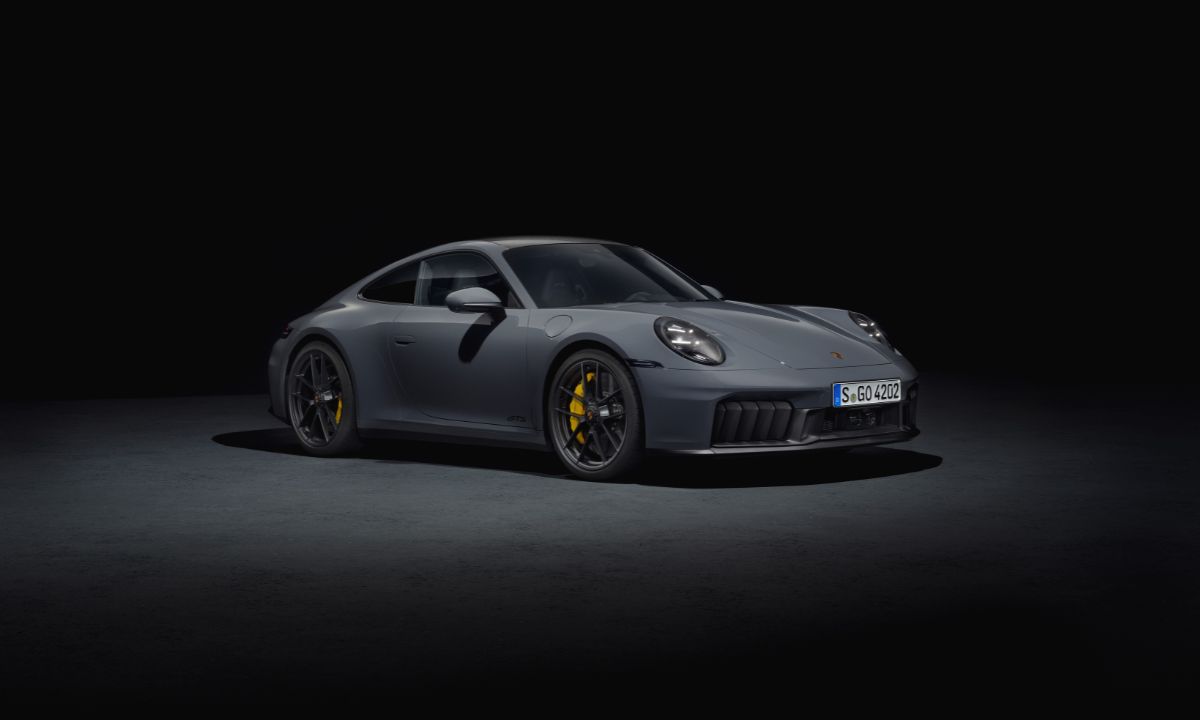

For more than six decades, the Porsche 911 has survived by obeying a strict philosophy of slow, meticulous evolution. While rival supercar manufacturers routinely throw out their engineering blueprints to chase transient design trends, Porsche’s Weissach development teams have historically relied on incremental adjustments. They keep the flat-six engine mounted firmly over the rear axle, continuously refining the vehicle’s legendary mechanical footprint.
But the unveiling of the mid-cycle facelift for the current generation known internally as the 992.2 presented Porsche engineers with their most dangerous existential challenge yet. Faced with tightening international emissions laws, Porsche did the unthinkable: they introduced a hybrid powertrain to the 911 lineage.
For purists, this felt like an impending disaster. Yet, by looking past the marketing jargon and examining the factual data, the 992.2 generation emerges not as an compromised eco-appliance, but as a masterpiece of pure motorsport-derived engineering.
The T-Hybrid Blueprint: Zero Belt Accessories, Maximum Voltage
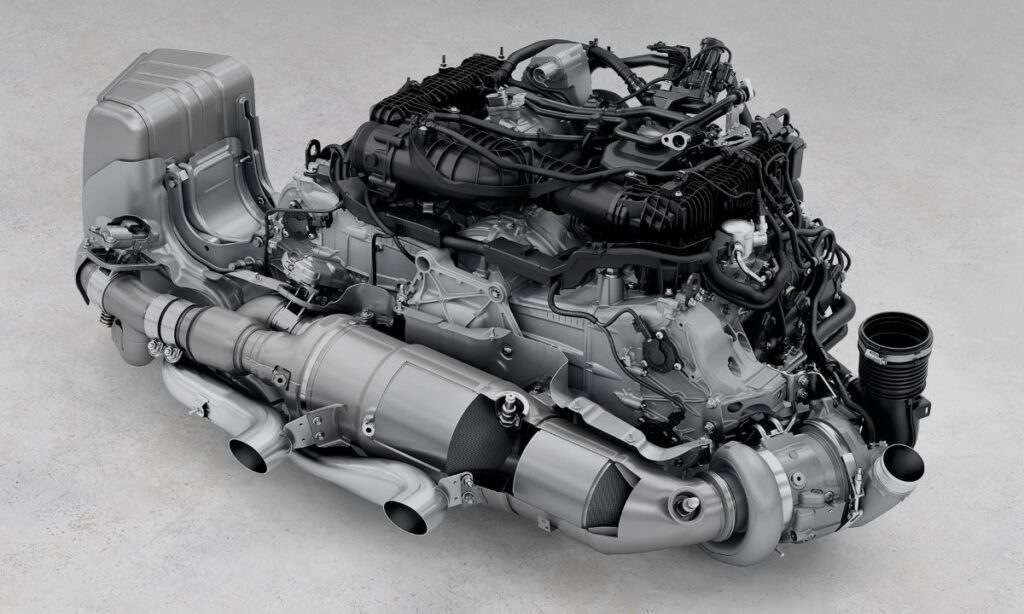
The core breakthrough defining the 992.2 layout is that it completely avoids the heavy, lethargic plug-in hybrid (PHEV) architecture utilized by standard commuter cars. There is no heavy plug-in battery pack and there is zero pure-electric driving range. The electrification exists purely to serve high-performance output.
Dubbed the T-Hybrid system, this configuration operates on a high-voltage 400-volt electrical architecture. By migrating the car’s ancillary components such as the air conditioning compressor and power steering pumps over to electric operation, Porsche completely eliminated traditional mechanical belt-driven accessories from the front of the block.
This drastic packaging efficiency allowed engineers to develop a downsized, larger-displacement 3.6-litre boxer flat-six that sits lower and tighter in the engine bay, maintaining the vehicle’s optimized low center of gravity.
Erasing Turbo Lag: The F1-Derived eTurbo
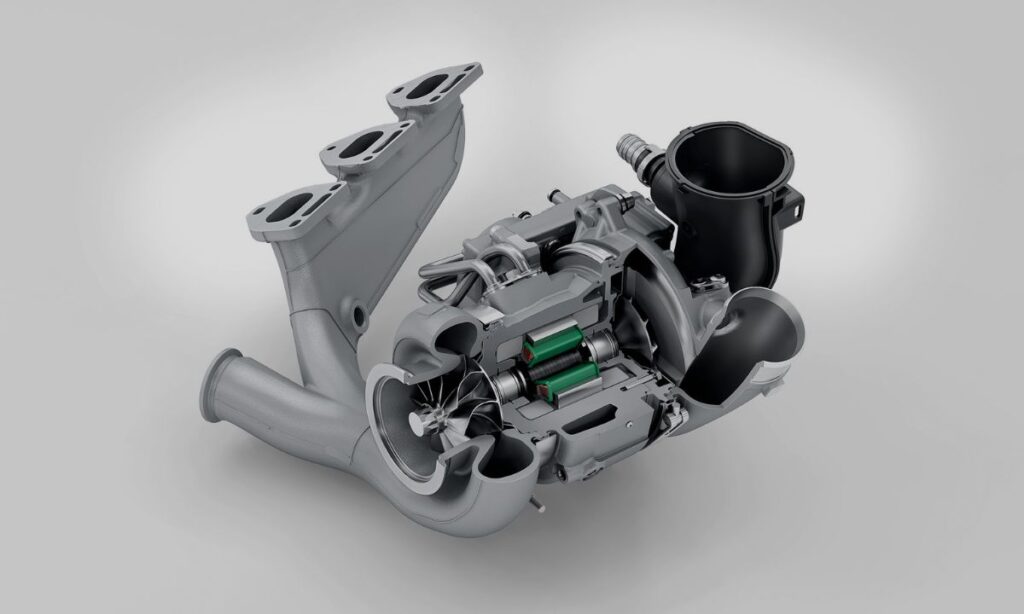
In traditional high-boost engine tuning, choosing a massive single turbocharger results in severe turbo lag the frustrating delay while exhaust gas pressure slowly builds up to spin the turbine wheel. Porsche solved this by integrating an electric motor directly onto the central turbine shaft inside their custom eTurbo setup.
When the driver hits the throttle, the integrated electric motor instantly draws up to 20kW of energy, spinning the turbine up to 120,000 RPM and building a peak 26.1 PSI of boost in less than 0.8 seconds. To put that into perspective, the twin-variable-vane turbochargers on the outgoing 992.1 GTS took nearly three full seconds to reach maximum compression from a standing start.
The eTurbo acts identical to an F1-style MGU-H (Motor Generator Unit – Heat). Once the exhaust gas volume takes over at high RPM, the electric motor reverses function to act as a generator, recovering up to 11kW of energy to charge the ultra-compact, 1.1 kWh lithium-ion battery positioned over the front axle.
Performance Metrics: The Fact Sheet
By pairing the 3.6-litre combustion engine with a permanent-magnet assist motor integrated directly into the housing of the 8-speed PDK dual-clutch transmission, the combined system output achieves astonishing performance metrics.
| Performance Metric | Pre-Facelift 992.1 GTS | New 992.2 T-Hybrid GTS | Net Change / Impact |
|---|---|---|---|
| Combined Power Output | 353 kW (473 hp) | 397 kW (532 hp) | +44 kW (+59 hp) |
| Combined Peak Torque | 570 Nm (420 lb-ft) | 610 Nm (449 lb-ft) | +40 Nm (+29 lb-ft) |
| 0–100 km/h Acceleration | 3.4 seconds | 3.0 seconds (2.5s tested) | Shaves nearly a full half-second. |
| Boost Target Pressure | 18.6 PSI | 26.1 PSI | Massive low-end torque delivery. |
The Lambda = 1 Engineering Victory
Historically, high-performance turbocharged sports cars have been forced to run a “rich” fuel-to-air mixture under heavy track loads to keep internal exhaust temperatures cool, which causes a significant spike in tailpipe emissions.
Because the T-Hybrid system can instantaneously modulate boost and throttle response using electric energy, the 992.2 GTS is engineered to run at a perfect stoichiometric ratio of Lambda = 1 (14.7:1 air-to-fuel ratio) across its entire operating range. Even under wide-open throttle at the track, the combustion cycle remains perfectly clean and optimized, eliminating the need to over-fuel the cylinders.
The Digital Cockpit Controversy
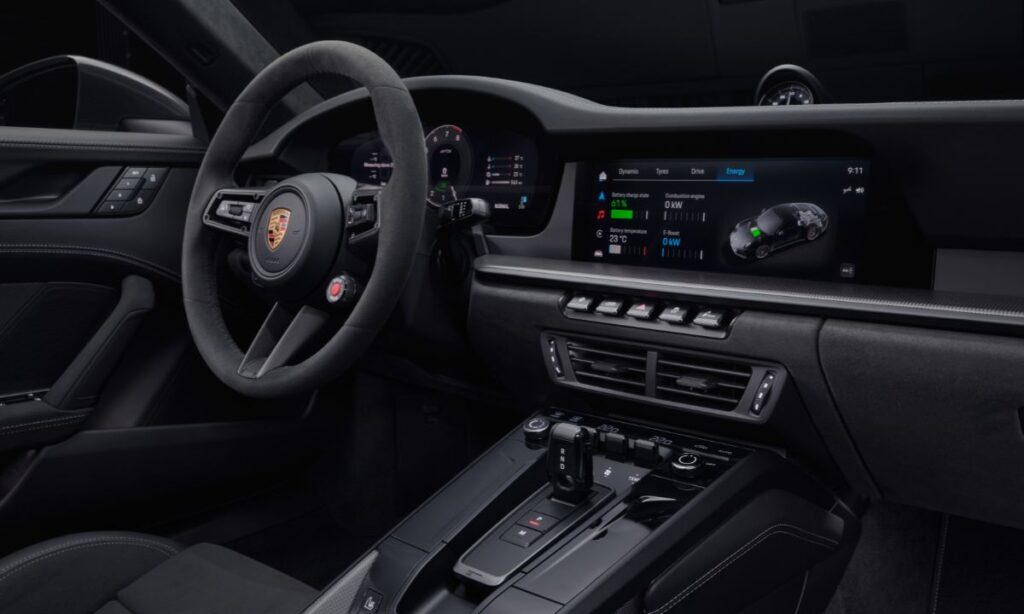
While the mechanical platform represents an uncompromised performance victory, the interior updates of the 992.2 have drawn intense debate from traditionalists. For the first time in the 911’s history, the iconic physical, central analog tachometer has been permanently retired.
In its place sits a high-fidelity, 12.6-inch fully digital curved instrument cluster. While removing the physical mechanical needle strips away a degree of nostalgic charm, the digital interface allows for immense functional adaptation. Drivers can toggle through diverse display layouts including a track-specific viewing mode that rotates the digital dial to place the 7,500 RPM redline directly at the 12 o’clock position, mirroring classic racecar configurations.
The RaceWire Verdict
The 992.2 Porsche 911 is a stark reminder that true automotive progress isn’t measured by simply clinging to legacy hardware. By utilizing a compact, high-voltage 400-volt architecture to eradicate turbo lag and maintain perfect combustion integrity under heavy load, Porsche has used electrification to make the 911 faster, sharper and more engaging than ever before. It isn’t a diluted hybrid; it is a street-legal application of elite motorsport technology that ensures the survival of the flat-six sports car for another generation.