


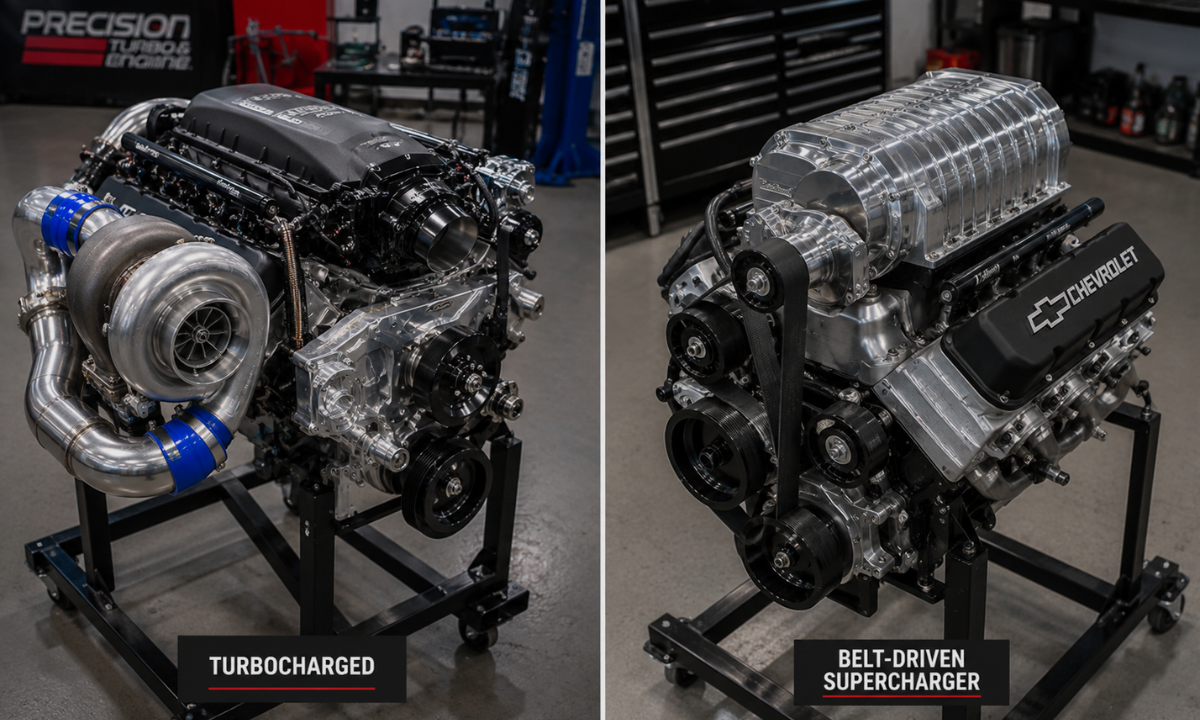

If you want to extract serious horsepower from a naturally aspirated engine, adding forced induction is the most effective path forward. By compressing incoming air and forcing more oxygen into the combustion chambers, both turbochargers and superchargers allow your engine to burn more fuel and make massive power gains.
However, choosing between the two isn’t just about chasing a peak horsepower number on a dyno. It’s about how that power is delivered to the tarmac.
When upgrading a modified car, deciding between a turbocharger and a supercharger comes down to understanding two competing engineering trade-offs: boost lag versus parasitic loss.
The Mechanical Division: How They Make Power
The core difference between the two systems lies entirely in how they are powered.
[Turbocharger] ➔ Driven by wasted exhaust gas ➔ Higher peak power & efficiency
[Supercharger] ➔ Driven by engine belt/crank ➔ Instant throttle response & linear torque
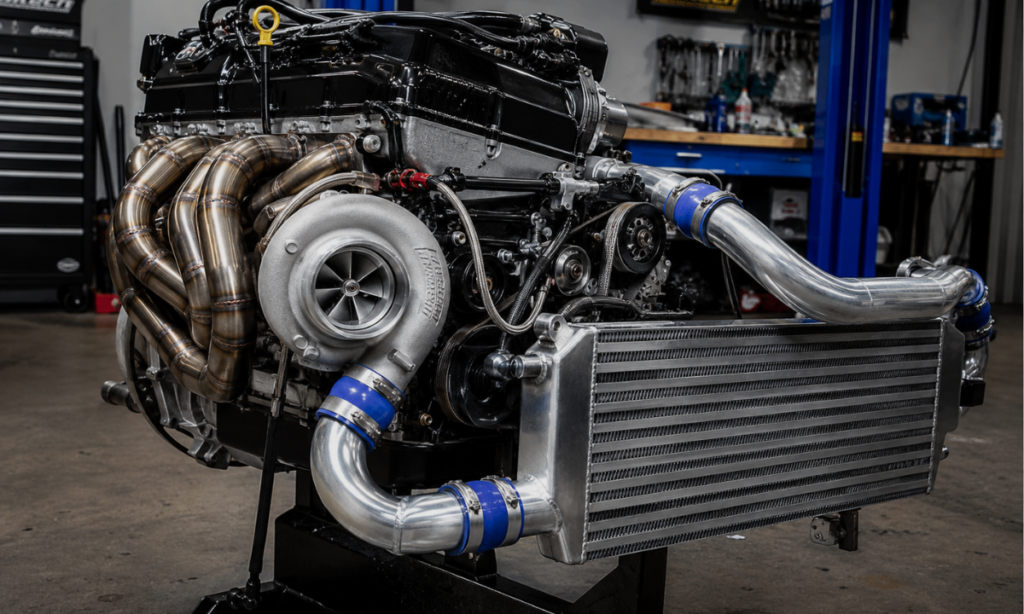
- Turbochargers: A turbo uses expanding exhaust gases leaving the engine to spin a turbine, which drives an air compressor. Because it recycles “free” waste energy, it is highly efficient and capable of massive top-end power. However, waiting for exhaust pressure to build creates a brief delay before boost kicks in commonly known as turbo lag.
- Superchargers: A supercharger is mechanically linked to the engine’s crankshaft via a belt drive. Because it turns directly with engine RPM, power delivery is instantaneous with zero lag. The downside? The belt drive draws mechanical power directly from the engine to run the unit, creating parasitic loss that slightly hurts overall fuel economy.
Head-to-Head Feature Comparison
| Modifying Factor | Turbocharger Upgrade Kit | Supercharger Upgrade Kit |
| Power Source | Recycled exhaust gas energy | Direct crankshaft belt drive |
| Throttle Response | Delayed (Dependent on spool time) | Instantaneous (Zero lag) |
| Peak Power Potential | Extremely high (Top-end heavy) | Strong low-to-mid range torque |
| Tuning Flexibility | High (Boost controlled via wastegate) | Fixed ratio (Requires pulley swaps) |
| Thermal Load | High exhaust heat under bonnet | High parasitic engine drag |
Real-World Drivability: Which One Suits Your Build?
For track weapons, circuit racers and highway drag cars, turbochargers are usually the preferred choice. Electronic wastegates allow tuners to adjust boost pressures on the fly, making it easy to dial in safe daily maps or aggressive high-boost race tunes.
For street cars, daily drivers and heavy towing setups, a supercharger is hard to beat. The immediate low-end torque gives you instant surge as soon as you touch the gas pedal, making the car feel like it has a much larger naturally aspirated engine under the hood.
The Verdict
There is no single winner in the forced induction debate only the right tool for your specific build goals.
If you want absolute peak horsepower, modular boost control and superior efficiency from a smaller engine, go turbo. If you want immediate throttle response, a linear power curve and a simpler bolt-on installation without modifying your exhaust manifold, a supercharger is your best bet.