



The capital-intensive nature of building an electric vehicle company from scratch is a notoriously brutal financial exercise. Startups frequently find themselves caught in a high-burn trap possessing highly advanced, industry-leading software stacks but lacking the deep-pocketed manufacturing infrastructure required to achieve true mass-market economies of scale.
But a profound corporate alliance is fundamentally rewriting the playbook on how upstart EV tech integrates with legacy automotive giants.
Volkswagen Group officially unlocked a fresh $1 billion (USD) investment tranche directly into Rivian. Far from a speculative cash bailout, this massive funding injection was automatically triggered by a critical technical milestone: the flawless completion of extreme sub-zero validation testing on Volkswagen prototype fleets running Rivian’s proprietary electronic architecture. For the broader automotive landscape, this deal signals a massive shift away from legacy, decentralized vehicle electronics toward highly consolidated, software-defined platforms.
The Testing Crucible: Validating the ID. EVERY1
The latest financial wire stems from a 50/50 joint venture forged between the two conglomerates, operating under the entity “Rivian and Volkswagen Group Technologies” (RV Tech). The baseline agreement outlines a progressive capital layout that could scale up to $5.8 billion if strict engineering targets are continually met.
To unlock the current $1 billion tranche, a combined international team of engineers from Volkswagen, Audi, Scout Motors and Rivian had to prove that Rivian’s core technology could survive real-world deployment on German hardware.
- The Blueprint: Engineers equipped a custom Volkswagen prototype dubbed the ID. EVERY1 alongside test beds from Audi and Scout Motors, with Rivian’s integrated electrical architecture.
- The Arctic Stress Test: The engineering test mules were shipped to specialized testing facilities in northern Sweden. Over months of relentless dynamic testing in sub-zero alpine conditions, the teams successfully validated the vehicle’s core electrical loops, chassis dynamics and real-time Over-the-Air (OTA) software updates under extreme thermal stress.
Understanding Zonal Architecture: The True Software-Defined Vehicle
To understand why a massive automotive empire like the Volkswagen Group is willing to pour billions into an American startup, you have to look closely at the physical wiring architecture hidden beneath a vehicle’s body panels.
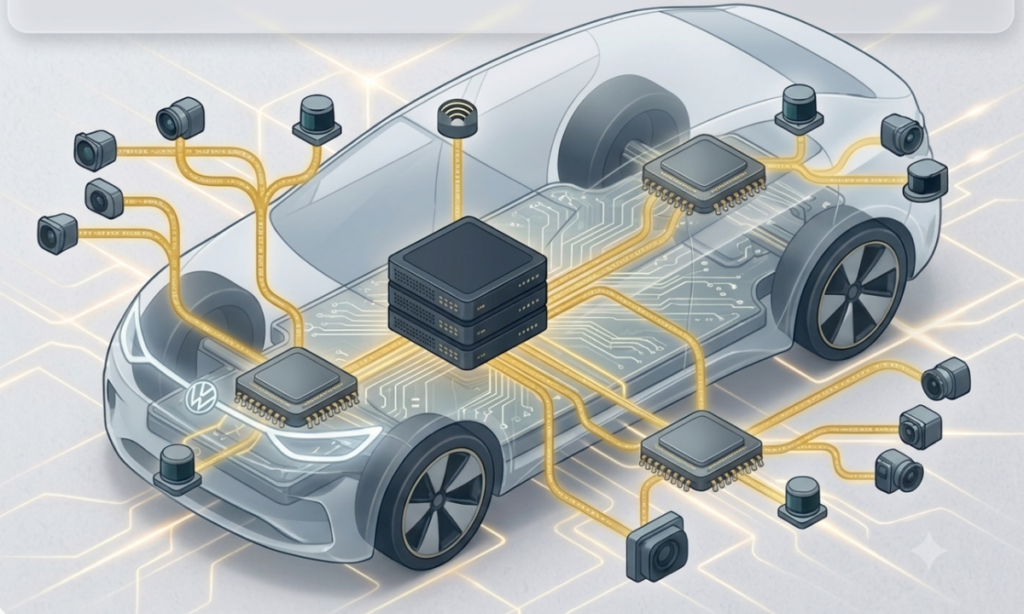
Traditional modern cars are exceptionally messy electronic ecosystems. They typically rely on up to 70 to 100 individual Electronic Control Units (ECUs) sourced from dozens of different third-party suppliers. One computer manages the electric windows, another controls the climate loops and a completely separate unit processes the braking logic. Getting these disparate modules to cleanly talk to each other requires kilometres of heavy, expensive copper wiring harnesses and makes updating the car’s software almost impossible.
Rivian’s Software-Defined Vehicle (SDV) architecture completely blows up that legacy approach. It simplifies the vehicle’s nervous system down into just three centralized modular computers connected to localized zonal distribution hubs. By running the entire vehicle off a unified, ground-up operating software layer, Volkswagen can instantly deploy highly automated driving features, optimize battery thermal management profiles and roll out entire cabin infotainment overhauls via standard cloud-based OTA updates entirely eliminating the need for customers to visit a physical dealership service center.
The Strategic Win-Win: Liquidity Meets Scale
This successful milestone represents a massive strategic victory for both sides of the boardroom table.
1. The Rivian Perspective: Securing the Runway
For Rivian, the timing of this $1 billion cash infusion could not be more critical. Roughly $750 million arrives as a direct equity investment, with the remaining $250 million structured as equity or convertible debt tied to final prototype sign-offs. This massive liquidity buffer drastically reinforces Rivian’s balance sheet, extending their guided available liquidity to nearly $8 billion. This capital runway is essential for de-risking the high-volume scaling phase of their highly anticipated Rivian R2 SUV, a mass-market platform that utilizes the exact simplified zonal architecture validated by Volkswagen in Sweden.
2. The Volkswagen Perspective: Bypassing the Software Bottleneck
For Volkswagen, paying a premium to license Rivian’s functional software stack allows the German giant to cleanly bypass years of internal software development delays. VW Group CEO Oliver Blume confirmed that the brand is already moving specialists to RV Tech hubs in Palo Alto to integrate this zonal platform across upcoming model lines for individual Group brands, including Audi and Porsche. It gives the corporate giant a mature, production-ready operating system capable of competing head-to-head with modern digital-first vehicle architectures.
The Verdict
The expansion of the Volkswagen-Rivian joint venture proves that the future of premium electric cars isn’t merely won through battery chemistry or electric motor efficiency it is won through software architecture. By turning their proprietary operating platform into a high-value technology asset for external legacy marques, Rivian has successfully generated an entirely new revenue stream while stabilizing their operational runway. For the consumer, it means the next generation of global European EVs will finally possess the rapid, seamless and deeply integrated digital soul they expect.